Isla de la Juventud and el Primero de Mayo.
1 05 2008Last weekend I continued my trend of traveling by paying a visit to Cuba’s largest island, Isla de la Juventud (Isle of Youth). We got up early Friday morning and after about half an hour searching the bus station, we finally found the check-in line and eventually got on the Astro bus heading to Batabanó, the departure port for Isla. I knew that we’d be riding on a high-speed catamaran, but I had no idea how nice the boat was going to be until I got aboard. For those of you in New England, this resembles the New England Fast Ferry except that it also is equipped with flat screen TVs that show the latest movies and shows from the U.S. (the ones that aren’t out on DVD yet). The ferry is also equipped with high security than we have at airports including police patrols (on board), metal detectors, and X-rays; this boat could easily out run the Cuban Coast Guard and be used to emigrate to Mexico. The 80 km journey took about two and a half hours and about six hours after leaving Havana we were in Nueva Gerona, capital town of Isla de la Juventud. After getting settled and making our excursion reservations with EcoTur, we explored Nueva Gerona and spent the rest of our night at the local bar, El Cochinito.
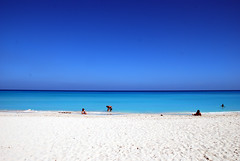
Saturday morning I was up early again, this time to head across the island to Punta Frances, the southwest corner of the island that is inaccessible by road and today largely hosts a nature preserve. To get there, we took a taxi to El Colony and then boarded an old 40 foot Sportfisher which took us the rest of the way by sea. It was great to be out on the water again (as opposed to stuck inside the ferry). The beach site we were at used to be very popular when the Spanish Oceanliner Pulmantur made weekly stops here, but since that vessel was bought by a U.S. firm it is no longer allowed to touch Cuban waters (Helms-Burton Act). The positive side of that transaction is that the beach is completely empty. We spent the morning snorkeling and then after convincing the Captain that my Firefighter’s ID included SCUBA certification, I departed for an afternoon dive in one of the many coral reefs that surround the area.
I should start by saying that I’ve never been diving before, but heard that Cuban waters were something not to be passed up. After a five minute crash-course, I jumped off the stern of our boat and after deflating my vest, began to descend into the reef. It took a few (excruciating) moments to get used to the pressure, but after then I enjoyed all 48 minutes that I stayed under water. Think about all those ridiculous pictures of absurdly blue waters and ridiculously beautiful fish that you’ve seen in magazines and on the internet. It was just like that.
Back in Nueva Gerona, the time for the second amazing part of the day was nearing: our surf and turf dinner (off the black market, of course). We shared four lobsters and at least two pounds of steak for the five of us (plus all the fixings)! With a long day of being on the beach and walking around town behind us, we went to bed early to begin our return trip at 6:30 a.m. on Sunday, arriving back in Havana without too much difficulty by 1:30 p.m. The rest of the week went by without too much event… until today that is.
May 1–Día de los Trabajadores—is one of three major holidays in Cuba (in addition to July 26 and January 1). Pretty much everything gets shut down as people prepare to march on the Plaza de la Revolución. By 6:30 a.m., the streets are bustling with activity as people converge on starting points for the various routes that take people right to the José Martí monument in the center of the city. I met up with other students from Filosofía e Historia and by 7:30 a.m., the march had begun. The colors of the day are red, white, and blue (the colors of the Cuban flag) and loud speakers carry revolutionary chants across the city.
More of a time to relax and socialize, the only real moment where everyone seemed to be actively participating in the march was passing under the watchful eyes of Raúl and other top government figures, some of whom use binoculars to better see the crowd. That isn’t to say that people don’t support the State, but as you can imagine, there’s only so many times you can say ¡Viva Raúl! or ¡Viva Cuba Libre! before it gets repetitive. Nevertheless, when the FEU was called, my entire section went crazy for about a minute, waving Cuban flags and shouting revolutionary chants.
I ran into one of my friends who is a Chilean journalist and managed to take my camera and get an incredibly close-up picture of Raúl himself (who is in the center of the whole event). After then, the march just sort of ended and people go their own ways, but I stayed around for a few extra minutes to see two important groups: the medical students (a few of whom flew U.S. flags) and trabajadores sociales (social workers) who flew hundreds of Cuban flags and street sized banners with slogans including one with Fidel’s picture. By evening, most of the events had finished and things were quiet as people got some much needed rest from such an early start. That’s what I’m about to do. Until next time.